

SPARTANBURG • DUNCAN • GREENVILLE, SC

Hand & Wrist

Wrist and Hand Surgeons in Spartanburg, Duncan, and Greenville, SC
Board Certified Specialists 1

Board-Certified Specialists

Rapid Appointments 1

Rapid Appointments

Minimally Invasive Options 1

Minimally Invasive Options

247 Expert Access 1

24/7 Expert Access

OVERVIEW

Hand and Wrist Surgeons in South Carolina

Carolina Orthopaedic & Neurosurgical Associates (CONA) offers specialized care for hand and wrist pain across South Carolina. With advanced techniques and a focus on minimizing pain while restoring function, our skilled hand and wrist specialists provide both surgical and non-surgical solutions. Given the critical role of the wrist in daily activities such as cooking, typing, and cleaning, any pain or discomfort can significantly disrupt your quality of life. Our team is dedicated to helping you regain function and reduce pain to improve your daily experience.

What Causes Hand and Wrist Pain?

Hand and wrist pain can result from a variety of conditions and injuries that affect the bones, muscles, tendons, ligaments, or nerves. Common causes include injuries such as sprains, strains, and fractures that often occur from sudden impacts like falling onto outstretched hands. Repetitive stress is another frequent cause, resulting from repeated wrist motions during activities like typing or sports, which can inflame tissues and cause discomfort.

Arthritis is another contributor to wrist pain. Osteoarthritis, characterized by cartilage deterioration in the wrist joint, is more common in individuals with a history of wrist injuries. Rheumatoid arthritis, an autoimmune condition, can lead to pain and swelling in both wrists. Conditions such as carpal tunnel syndrome, which compresses the median nerve in the wrist, or ganglion cysts, which are fluid-filled lumps near the wrist, can also cause pain and interfere with wrist function. If self-care measures do not alleviate your symptoms, consulting a specialist is essential for accurate diagnosis and effective treatment.
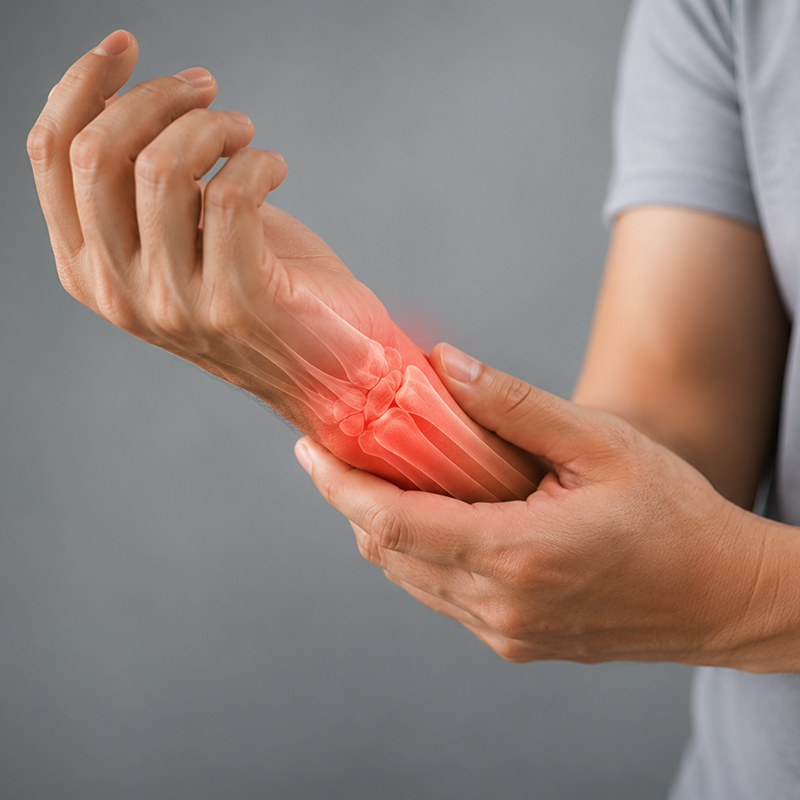
What Causes Hand and Wrist Pain
TREATMENTS

How Is Wrist Pain Treated?

Treating wrist pain depends on identifying the root cause. For minor issues related to overuse, self-care methods such as rest, ice, and over-the-counter medications like ibuprofen can reduce pain and inflammation. However, more complex injuries or chronic conditions often require a thorough evaluation by a specialist to determine the most effective course of action.

Non-surgical treatments, including physical therapy and corticosteroid injections, are commonly used to relieve symptoms and restore function. Physical therapy focuses on strengthening the wrist and improving mobility, while injections can temporarily reduce inflammation.

When non-surgical approaches are insufficient, surgical options such as tendon transfer surgery or wrist joint replacement may be recommended. At CONA, we prioritize non-invasive treatments and only consider surgery after exploring all other options.


Common Hand & Wrist Treatments:

Steroid Injections

Steroid Injections

Steroid injections are a minimally invasive treatment option for wrist arthritis. Pain-relief occurs quickly if not immediately after the short in-office procedure and patients are able to return to normal day-to-day activities.

Click To Learn More

Tendon Transfer Surgery

Tendon Transfer Surgery

A tendon transfer surgery removes an unhealthy hand tendon and replaces it with a new one. Patients can move their hand without any problems after recovery and pain and other symptoms dramatically decrease.

Click To Learn More

Wrist Joint Replacement Wrist Arthroscopy

Wrist Joint Replacement (Wrist Arthroscopy)

Wrist joint replacement (wrist arthroplasty) is a surgical treatment option for wrist arthritis. The procedure effectively reduces symptoms and improves wrist joint mobility and function.

Click To Learn More

COMMON HAND & WRIST CONDITIONS

Understanding Common Hand and Wrist Conditions

Hand and wrist pain can arise from various conditions, including fracturessprainsarthritis, carpal tunnel syndrome, and trigger fingers. Other common conditions include Dupuytren’s contracture, De Quervain’s tendinitis, and ulnar tunnel syndrome. Injuries to tendons and lacerations, as well as complex regional pain syndrome, can also affect the wrist and hand. At CONA, we specialize in treating these and other conditions, using non-surgical methods whenever possible and reserving surgery where all other options have been explored.

Your surgeon may call for an X-ray, electrocardiogram, MRI scan, computed tomography (CT) scan, Biopsy, or a more extensive evaluation to safely perform your surgery. Make sure to follow the instructions on when to stop eating or drinking before your surgery to avoid choking on stomach contents during anesthesia.

If you smoke, you may want to stop because smoking can slow your healing and recovery. Try to shed a few pounds if you’re overweight.

Take note of things you need to do post-surgery. For example, what exercises can help with recovery? How long should you stay off work? Will changes in your diet be required?.

At Carolina Orthopaedic and Neurosurgical Associates (CONA), our board-certified physicians can help you get back to the things you love as fast as possible. Click the button below today to book an appointment at one of our locations.

HAND & WRIST CONDITIONS

Common Hand & Wrist Conditions

Hand Fracture
A hand fracture or broken hand occurs when one of the hand bones is broken. Like all fractures, a hand fracture should be seen by a Carolina Orthopaedic and Neurosurgical Associates’ (CONA) hand specialist as soon as possible. Early treatment reduces symptoms and starts the bone healing process.

Click To Learn More

Broken Wrist
The distal radius and scaphoid are two important wrist bones. A broken wrist happens when either of the bones is fractured. A broken wrist is a serious injury that requires medical attention. An appointment with a Carolina Orthopaedic and Neurosurgical Associates’ (CONA) should be made as soon as possible.

Click To Learn More

Wrist Sprain
A wrist sprain occurs when a wrist ligament is overstretched or partially torn. When diagnosed and treated properly, a wrist sprain heals quickly—symptoms are reduced and the patient returns to normal activities with minimal to no restrictions. Patients who injure their wrist and experience wrist sprain symptoms should make an appointment with a Carolina Orthopaedic and Neurosurgical Associates’ (CONA) hand specialist as soon as possible.

Click To Learn More

Carpal Tunnel Syndrome
Carpal tunnel syndrome is a common condition that affects many patients. Various causes may compress the nerve that innervates the hand and fingers and cause unpleasant symptoms. Early carpal tunnel treatment reduces symptoms and treats carpal tunnel syndrome before it gets worse. An appointment with a Board-Certified and Fellowship-Trained Carolina Orthopaedic and Neurosurgical Associates (CONA) hand specialist should be made at the first sign of symptoms.

Click To Learn More

Hand & Wrist Arthritis
Arthritis is the inflammation of joint bone, cartilage and soft tissue. Two types of arthritis affect the hand, thumb and wrist:

Osteoarthritis. “Wear and tear” arthritis.
Rheumatoid arthritis. Immune system arthritis.

Early arthritis treatment is always best. A nonsurgical treatment plan reduces symptoms and prevents the condition from becoming worse. Patients who experience arthritis of the hand, thumb or wrist symptoms are encouraged to make an appointment with a Carolina Orthopaedic and Neurosurgical Associates’ (CONA) hand specialist as soon as possible.

Click To Learn More

Ganglion Cyst
A ganglion cyst is a noncancerous mass or lump in the hand or wrist. Cysts come and go and usually do not produce symptoms. When symptoms do present, they may make it difficult to move the hand or wrist without discomfort or pain. An appointment with a Carolina Orthopaedic and Neurosurgical Associates’ (CONA) hand specialist should be made as soon as possible.

Click To Learn More

Trigger Finger
Trigger finger occurs when a finger catches or locks as it flexes or straightens. Trigger finger symptoms make it difficult to use the fingers and hand, especially if the finger remains locked. An appointment with a Carolina Orthopaedic and Neurosurgical Associates’ (CONA) hand specialist should be made as soon as symptoms present. Delaying treatment makes trigger finger worse.

Click To Learn More

Dupuytren's Contracture
Dupuytren’s contracture is thickening of the hand fascia—the fibrous layer of hand tissue. The fingers pull toward the palm of the hand and remain stuck, which makes it difficult to perform many hand movements required for normal day-to-day living. A Carolina Orthopaedic and Neurosurgical Associates’ (CONA) hand specialist prescribes a customized treatment plan to treat Dupuytren’s contracture and reduce symptoms.

Click To Learn More

DeQuervain's Tendinitis
De Quervain’s tendinosis is inflammation of the wrist tendons on the side closest to the thumb. De Quervain’s symptoms make it difficult to use the wrist when performing day-to-day activities like writing and grabbing and gripping objects. A Carolina Orthopaedic and Neurosurgical Associates’ (CONA) hand specialist prescribes a customized treatment plan to treat inflammation and reduce symptoms.


Click To Learn More

Ulnar Tunnel Syndrome
Ulnar tunnel syndrome is compression of the ulnar nerve at the wrist. Symptoms present in the little and ring fingers and make it difficult to pinch and grip. A Carolina Orthopaedic and Neurosurgical Associates’ (CONA) wrist specialist’s customized treatment plan quickly reduces symptoms.

Click To Learn More

Tendon Injuries and Lacerations
The flexor tendons are located in the forearm, hand, and fingers. The tendons are important because they control hand movement, specifically finger and thumb bending. Flexor tendon injuries may make it impossible to properly use the hand. Patients who experience flexor tendon injury symptoms should make an appointment with a Carolina Orthopaedic and Neurosurgical Associates’ (CONA) hand specialist as soon as possible.
Click To Learn More
Complex Regional Pain Syndrome
Complex regional pain syndrome occurs when the body abnormally responds to an injury. Symptoms that do not correspond to the injury type or location are experienced. The most common body part affected is the hand. Patients who experience complex regional pain symptoms in the hand are encouraged to make an appointment with a Carolina Orthopaedic and Neurosurgical Associates’ (CONA) hand specialist as soon as possible.
Click To Learn More
OUR SPECIALISTS

Meet the Team That Gets You Moving Again

Our hand and wrist specialists diagnose and treat injuries, pain, and conditions to restore strength, function, and mobility.

Dr Brown
HAND & UPPER EXTREMITY ORTHOPAEDIC SURGEON

David Brown, MD

Fellowship-Trained Hand & Upper Extremity Specialist

Maggie headshot copy
HAND & UPPER EXTREMITY ORTHOPAEDIC SURGEON

Maggie Luthringer, MD

Fellowship-Trained Hand & Upper Extremity Specialist

TL Headshot
HAND, SHOULDER & ELBOW ORTHOPAEDIC SURGEON

Tyler Luthringer, MD

Fellowship-Trained Upper Extremity Specialist

Why Choose CONA for Hand and Wrist Care

Why Choose CONA for Hand and Wrist Care?

At Carolina Orthopaedic & Neurosurgical Associates, our hand and wrist specialists are committed to providing exceptional care tailored to each patient’s needs. Whether your pain stems from an injury, overuse, or a chronic condition, we aim to restore function and relieve discomfort, enabling you to return to your daily activities as quickly and safely as possible. If you are experiencing persistent or worsening pain, contact us today to schedule an appointment. Alternatively, visit one of our walk-in urgent care clinics in Spartanburg, Duncan, or Greenville, SC, for immediate assistance. Let us help you regain comfort and functionality, allowing you to enjoy life without hand and wrist pain.
HAND & WRIST INJURY SYMPTOMS

Recognizing Symptoms of Hand and Wrist Injuries

The symptoms of hand and wrist injuries vary but commonly include pain, swelling, and tenderness. Some individuals may notice warmth or bruising in the affected area, while others experience a popping or tearing sensation.

Loss of motion, weakness, or difficulty gripping objects are potential signs of injury or a chronic condition. If you are experiencing these symptoms, significantly if they worsen over time or interfere with daily activities, it is essential to seek professional care. Our walk-in clinics in South Carolina offer prompt evaluations and treatment options without requiring an appointment.

FREQUENTLY ASKED QUESTIONS

Hand & Wrist FAQs

What hand and wrist conditions does CONA treat?
CONA’s hand and wrist specialists treat carpal tunnel syndrome, trigger finger, Dupuytren’s contracture, De Quervain’s tendinitis, ganglion cysts, hand and wrist fractures, wrist sprains, hand and wrist arthritis, ulnar tunnel syndrome, flexor tendon injuries, and complex regional pain syndrome. Our team offers both surgical and nonsurgical solutions tailored to each patient’s needs.
What is carpal tunnel syndrome, and how is it treated?
Carpal tunnel syndrome occurs when the median nerve is compressed as it passes through the narrow carpal tunnel in the wrist, causing numbness, tingling, and weakness in the hand and fingers. Mild to moderate cases are often treated with wrist splinting, activity modification, and corticosteroid injections. When symptoms are severe or don’t improve with conservative care, carpal tunnel release surgery is a highly effective option with a relatively quick recovery.
What is trigger finger, and can it be treated without surgery?
Trigger finger occurs when inflammation around a finger’s tendon causes it to catch or lock when bending or straightening. In early stages, rest and anti-inflammatory medications may help. Corticosteroid injections are effective for many patients. Surgery may be recommended for cases that don’t respond to other treatments or when the finger remains locked. Early evaluation at CONA is recommended to prevent the condition from worsening.
How do I know if my wrist is sprained or broken?
Both wrist sprains and fractures can cause pain, swelling, and difficulty moving the wrist, which makes them difficult to distinguish without imaging. A sprain involves stretched or partially torn ligaments, while a fracture means one or more bones are broken. X-rays are typically used to tell them apart. If you’ve injured your wrist, especially from a fall, it’s important to be evaluated by a CONA hand specialist as soon as possible — an untreated fracture can affect long-term wrist function.
What are the treatment options for hand and wrist arthritis?
CONA treats both osteoarthritis (wear-and-tear) and rheumatoid arthritis of the hand and wrist. Nonsurgical options include splinting, activity modification, anti-inflammatory medications, and steroid injections. When conservative treatments are no longer sufficient, surgical options such as wrist joint replacement (arthroplasty) or tendon transfer surgery may be considered. Our specialists prioritize the least invasive approach that provides effective relief.
How long does recovery take after hand or wrist surgery?
Recovery depends on the specific procedure. Carpal tunnel release typically allows return to light activities within weeks, while wrist joint replacement or tendon transfer surgery may require several months of rehabilitation. Occupational and physical therapy are an important part of most hand and wrist recoveries, helping patients rebuild strength, flexibility, and function. CONA’s care team will outline a recovery plan customized to your procedure and lifestyle.

Move Forward Fast.

Same-day appointments. Board-certified spine specialists. Free 24/7 expert advice. Don’t wait on your spine.
WHERE WE ARE

Find a Location Near You

NorthGroveoffice1 425x202 1
1330 Boiling Springs Rd, Ste 1660 Spartanburg, SC 29303
Duncan Office CONA
115 Deacon Tiller Ct. Duncan, SC 29334
Greenville Office CONA
220 Roper Mountain Road Ext.
Greenville, SC 29615